
Don't copy big brands' playbook: you're not big enough (yet)
Copying the brands you admire is tempting: the one-word slogan, the clever product name, the minimalist hero that says almost nothing. Big names get away with it because everyone already knows them, and what works at their stage works against you at yours. Four lessons follow, starting with why a 5% conversion rate means little on its own.
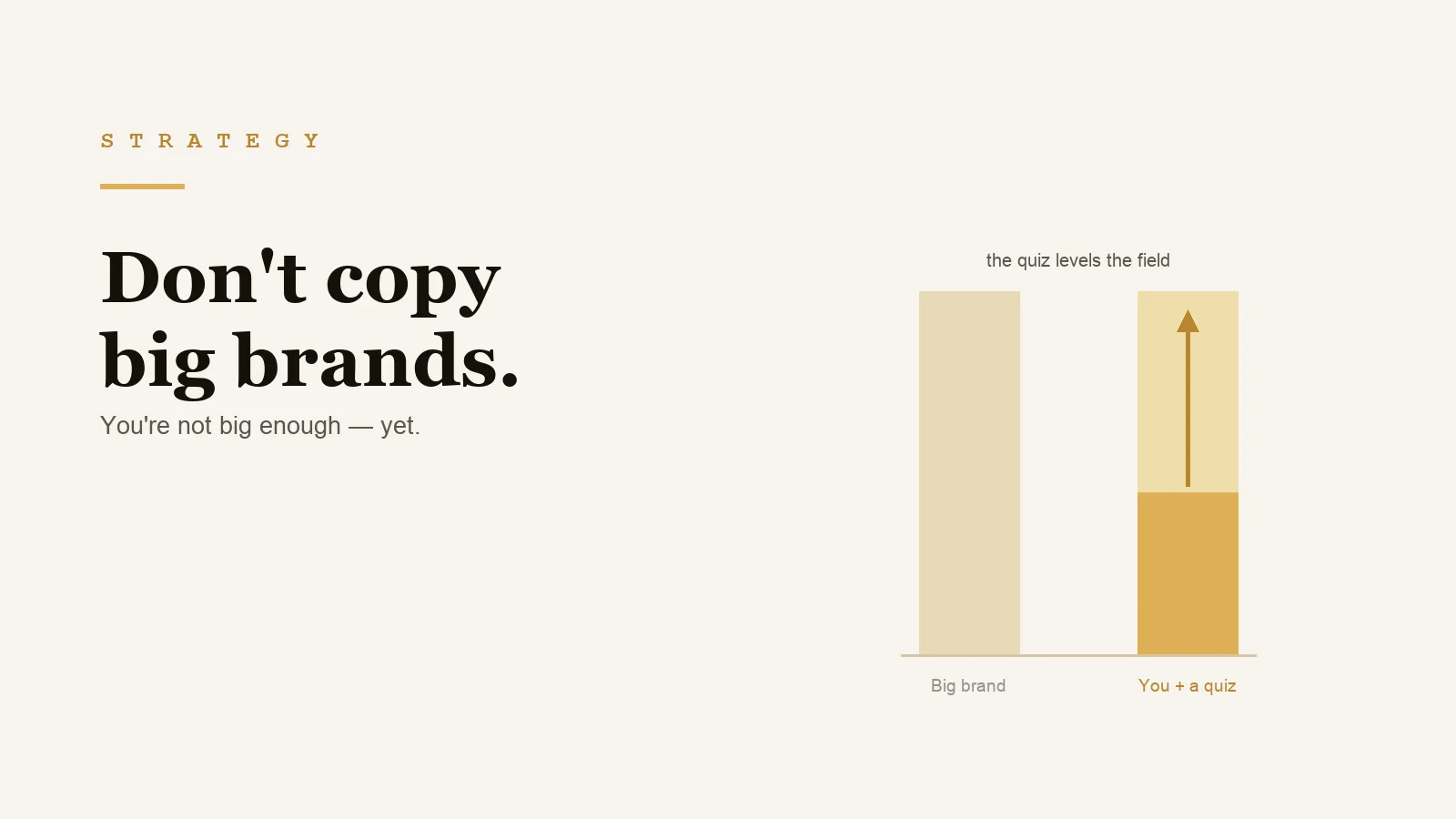
It's tempting to copy the brands you admire, the one-word slogan, the clever product name, the minimalist hero that says almost nothing. Big names get away with it because everyone already knows them. What works at their stage works against you at yours. Four lessons.
1. Conversion rate alone is misleading
A 5% conversion rate means little if returns are high, average order value is sliding, or no one comes back. Optimise for revenue per visitor, basket size, repeat purchase and lifetime value, not a vanity rate. A higher conversion rate isn't automatically higher revenue.
2. "Best practice" isn't universal
What works for a household supplement brand won't work for a fifty-euro serum. Category, price and device behaviour all differ, some products convert on a mobile impulse, others need desktop research. Optimise for how your customers actually decide, not a template copied from a brand playing a different game. A fifty-euro serum and a supplement subscription are not the same decision, and no best-practice list can tell them apart the way a Quizshopping quiz can.
3. More features usually mean less clarity
Competing CTAs, "boosting" apps, elements added just in case, they bury the path. CRO research repeatedly finds that leaner pages convert better than cluttered ones: one clear next step beats forty competing ones. Every app you install promises a lift on its own, and the page pays for all of them together, in load time and in the seconds a shopper spends deciding where to look first.
4. Big brands assume trust, you can't (yet)
A household name can use a vague slogan and a hero that says nothing, because the trust is already there. A growing brand can't assume people know what you sell, who it's for, or why you're different. While you are still earning trust, clarity is not optional, and Powerable would rather a page say the plain thing than the clever one.
Copy a big brand's confidence: not their shortcuts.
The one move that levels the field
Here's the throughline: and where a quiz changes everything. A big brand wins on borrowed trust and awareness. A growing brand wins on relevance. When a quiz recommends products from each shopper's own pain points, desires and language, it delivers what no big-brand shortcut can: a "this was made for me" moment that needs no prior fame. Quizshopping is the format that produces it.
That personalization is a huge lift, and it lets a smaller brand compete on the same premises as the giants, without their head start. It flips every lesson above in your favour: relevance over vague slogans, your customers' decision over a copied template, one clear recommendation over clutter, and clarity that earns trust on the spot.
Go deeper
Frequently asked
- So should I ignore what big brands do?
- No: learn their discipline (clarity, focus, restraint), not their shortcuts (vague slogans and borrowed trust). The shortcuts only work once everyone already knows you. A household name can afford a slogan that says nothing because the name already carries the meaning, while a growing brand has to put the meaning into the words themselves, which is the first thing Powerable looks at on a growing brand's page.
- What should I optimise for instead of conversion rate?
- Revenue per visitor, average order value, repeat purchase and lifetime value. A high conversion rate with high returns and no repeat custom isn't growth.
- How does a quiz help a smaller brand compete?
- It personalizes the recommendation to each shopper's own pain points, desires and language, relevance that doesn't depend on prior fame. That lift lets you compete on the same premises as much bigger brands.
See Quizshopping on your own traffic.
Turn the 95% who aren't ready to buy into a segmented pipeline.
Join the waitlist