
What are Category Entry Points (CEPs)?
Most shoppers do not wake up thinking about your brand. They think about a need, a moment, a trigger, and whichever brands come to mind in that moment get considered. Those triggers are Category Entry Points, developed by the Ehrenberg-Bass Institute, and they are the building blocks of how easily your brand comes to mind when a buying situation appears.
Most shoppers don't wake up thinking about your brand. They think about a need, a moment, a trigger, and whichever brands come to mind in that moment get considered. Those triggers are Category Entry Points.
What is a Category Entry Point?
A Category Entry Point (CEP) is a cue that makes someone think of a product category, the reasons, occasions and triggers at the very start of a buying decision. Developed by the Ehrenberg-Bass Institute (Prof. Jenni Romaniuk), CEPs are the building blocks of Mental Availability: how easily your brand comes to mind when a buying moment strikes.
The six CEP cues
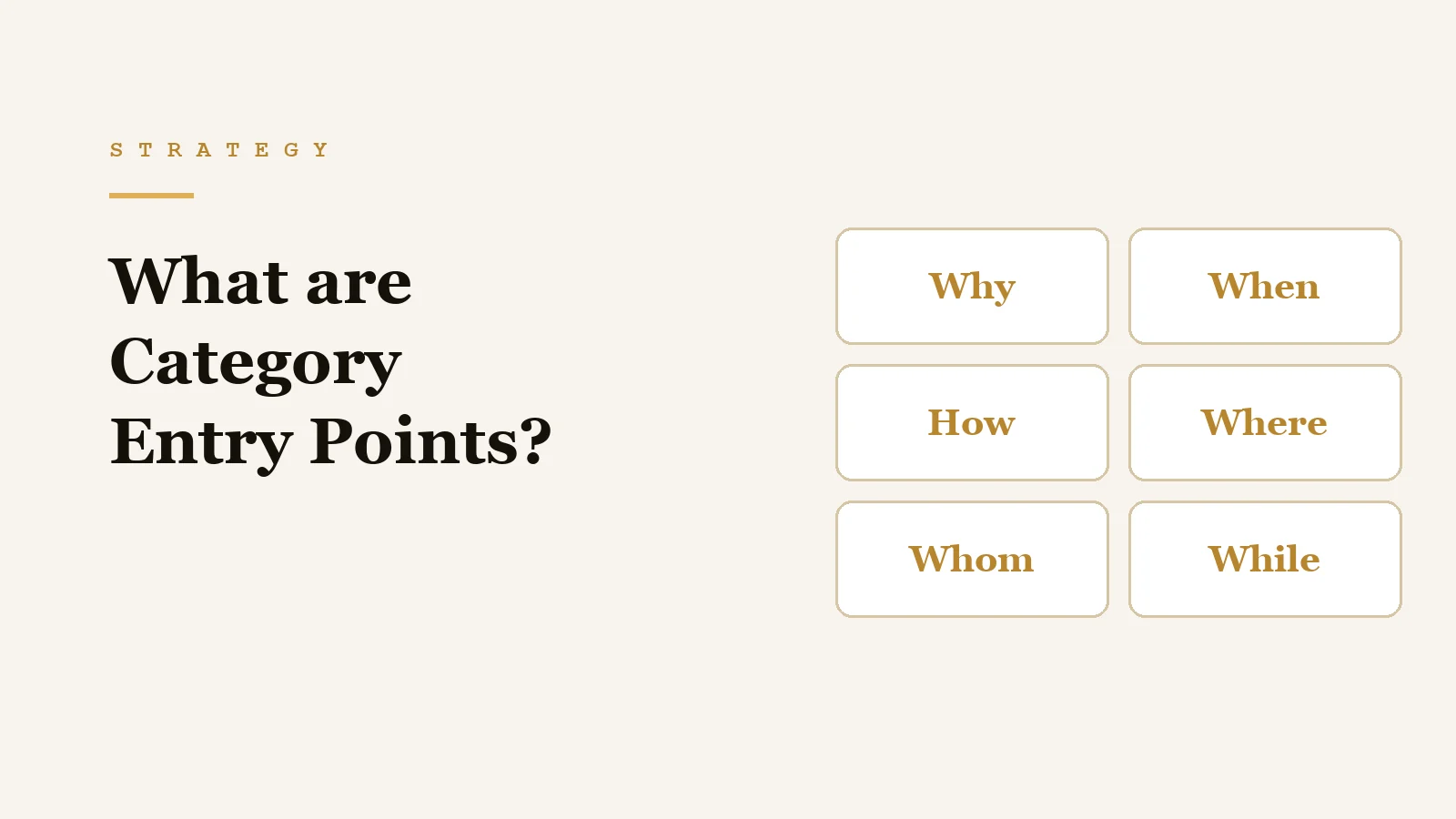
Every entry point can be mapped against six interrelated cues, and the Ehrenberg-Bass Institute treats them as a checklist rather than a theory. Work through all six for your own category and you end up with a list of the moments when someone could think of you, which is the raw material a quiz turns into questions.
- Why: the motivation behind the purchase
- When: the timing or occasion
- How: how the shopper is feeling
- Where: the location or channel
- With whom: who (or what) they're with
- While: what they're doing at the time
Map these and you've mapped the moments your brand needs to win.
Why CEPs matter
Brand growth comes from being easy to think of (Mental Availability) and easy to buy (Physical Availability). CEPs are how you build the first. A blunt "drive awareness" plan treats every moment the same; CEPs focus you on the specific occasions that actually trigger consideration.
How Quizshopping uses CEPs
A quiz is a fast, direct way to detect which entry point a shopper is in. The questions surface the why, when and how behind their visit, and the persona result matches the product to that moment, in their own words. Instead of one message for every occasion, each shopper meets the one built for theirs. It's CEPs made actionable, right at the point of conversion.
That's one ingredient in the hybrid behind every Bloom: proven behavioral science, your customers' real pain points and desires, their Category Entry Points, and our battle-tested experience.
Win the moments that matter: not just "awareness."
Frequently asked
- Who came up with Category Entry Points?
- The Ehrenberg-Bass Institute (Prof. Jenni Romaniuk), the same research tradition behind the 95:5 rule we build on. Romaniuk's work on Category Entry Points and Dawes' work on the 95:5 rule come out of the same institute, which is why the two ideas fit together so neatly inside one quiz.
- How are CEPs different from personas or segments?
- A persona reveals who the buyer is, and crucially their pain points and desires, while CEPs describe the buying situation: the why, when and how that brings the category to mind. They're different lenses, and CEPs aren't a segmentation: the same shopper enters the category through different CEPs on different occasions, so CEPs cut across buyers. You map CEPs at the category level, then use personas (and their pain points) to tailor how you respond.
- How many CEPs should we focus on?
- The few with the most buyers attached. Chasing the long tail of rare cues dilutes focus, win the moments that matter most first.
- How do CEPs relate to the 95:5 rule?
- Both come from Ehrenberg-Bass. CEPs build the mental availability that makes you come to mind when the 95% who aren't ready today re-enter the market.
- Can a quiz identify which CEP a shopper is in?
- Yes. The quiz's questions surface the why, when and how behind a visit, then match the recommendation to that moment, turning CEP theory into a conversion at the point of sale.
See Quizshopping on your own traffic.
Turn the 95% who aren't ready to buy into a segmented pipeline.
Join the waitlist